Wednesday, 14 September 2011
State of Play: budget honesty and policy costings in September 2011
This is what the Australian Gillard Government intends to implement:
1. The Parliamentary Service Amendment (Parliamentary Budget Officer) Bill 2011 (PSA Bill) would, if enacted, amend the Parliamentary Service Act 1999 , which governs the Parliamentary Departments, and other Acts to establish the Parliamentary Budget Office (PBO) and the position of the Parliamentary Budget Officer (the Officer), and the purpose, functions and governance of the PBO.
2. Specifically, the PSA Bill would:
· Establish the PBO as a fourth Parliamentary Department, establish the Officer as an independent officer of the Parliament, and provide for the employment of PBO staff and the governance framework of the PBO;
· Establish the mandate of the PBO to inform the Parliament by providing independent and non-partisan analysis of the budget cycle, fiscal policy and the financial implications of proposals;
· Establish the functions of the PBO to respond to requests for policy costings and other requests relating to the budget, from Senators and Members of the House of Representatives, with responses able to be undertaken in a confidential manner upon request outside of the caretaker period, and in a manner consistent with the Charter of Budget Honesty Act 1998 (the Charter) during the caretaker period;
· Enable the Officer to enter into arrangements to access information from Australian Government agencies, consistent with other legislative requirements ;
· Establish the duties and authority of the Presiding Officers in regards to the PBO, including overseeing the operation and administration of the PBO; and
· Establish the duties and authority of the Joint Committee of Public Accounts and Audit (JCPAA) in relation to the PBO, including enabling the JCPAA to consider the operations and work plan of the PBO.
3. The Bill would also amend several other Acts to enable the establishment of the PBO, namely:
· The Charter would be amended to extend the caretaker period in a manner consistent with the definition in the Guidelines on Caretaker Conventions to when a Government is sworn in following an election, clarify access to the election costing functions, minimise the duplication of policy costings, and update references within the Act;
· The Freedom of Information Act 1982 would be amended to include the PBO and the Officer as an exempt agency; and
· The Remuneration Tribunal Act 1973 and the Long Service Leave (Commonwealth Employees) Act 1976 would be amended to ensure that the Acts encompasses the position of the Officer.
4. The PSA Bill forms an important element of broader parliamentary reforms, which will enhance the credibility and transparency of the Commonwealth's already strong fiscal and budgetary frameworks. These changes have been developed in collaboration with the relevant Ministers and their Departments, and with the Presiding Officers.
5. The proposed amendments have no further impact to the underlying cash balance as funding of $24.9 million was allocated over 4 years to establish the PBO in the 2011-12 Budget.
This is what the Coalition under Tony Abbott asserts that it wants to see, as set out in Shadow Treasurer Joe Hockey's two private members bills:
· a new body, accountable to the Parliament rather than the Executive, much like the Auditor-General or Commonwealth Ombudsman;
· independent, to enhance the transparency and accountability of the budget process, and help deliver better policy and financial outcomes for Australian taxpayers;
· well resourced, to ensure it is effective;
· tasked with providing objective and impartial advice and analysis across the parliament on the Commonwealth budget and budget cycle, including the impact of major policy announcements; and
· headed by the Parliamentary Budget Officer, who will be appointed by the presiding officers of the parliament on the advice of a committee of senior government officials, with an office of highly trained staff, whose calibre will reflect the Office's status as an independent body.
FINANCIAL IMPACT
Clause 32(4) of the Bill stipulates that:
"The appropriation of funds for the PBO in a non-election year must not be less than 3.5% of the departmental appropriation for the Department of the Treasury."
OUTLINE
The Charter of Budget Honesty Act (1998) was intended to produce better fiscal outcomes through institutional arrangements to improve the formulation and reporting of fiscal policy.
A key element of the Charter were arrangements for more equal access to Treasury and Finance costings of election commitments by the Government and Opposition.
One shortcoming of these arrangements for the Opposition is that they require the agreement of the Prime Minister for Opposition costings to be submitted to the Departments of the Treasury and Finance.
They also require the public release of the costing of a policy which has been submitted.
These arrangements create an environment where costings are not confidential and cannot be challenged or reviewed prior to being made public.
The Coalition has introduced the Parliamentary Budget Office Bill 2011 which seeks to establish an independent statutory authority which will provide objective and impartial advice and analysis on:
· The Commonwealth Budget and budget cycle;
· Medium and long-term budget projections;
· The costs of policy proposals; and
· Other matters as requested by Members and Senators.
The policy costing function of the PBO will differ from that in the Charter of Budget Honesty. Requests by non government MPs or Senators for policies to be costed will not require the agreement of the Prime Minister. Further, the costings will be confidential as they will not be able to be released to the public without the express approval of the relevant MP or Senator.
The costings provision in the PBO will supersede and make redundant the comparable provision in the Charter of Budget Honesty.
The Charter of Budget Honesty Amendment Bill 2011 removes the redundant provisions from the Charter of Budget Honesty.
FINANCIAL IMPACT
This Bill will have no financial impact.
While this is what the House of Representatives 12 September 2011 debate reveals concerning the Coalition's bills:
· Should Joe Hockey's bills fail to pass and the government's poor imitation of a costing service pass this place, the coalition will not submit its policy costings to either the Treasury or the PBO prior to the election.
·· The MP or senator requesting a costing will control the timing of the release of the policy costing and No longer will requests for policy costings and the costings themselves be published as soon as they are received and prepared by the departments of Treasury and Finance. This provision applies at all times, even during an federal election campaign, and the electorate may never be told of the costings advice received because it must provide for policies not to be released at all if that is the decision of the relevant parliamentarian.
· The Parliamentary Budget Officer cannot publish anything in relation to a request to provide advice made by an individual Member or Senator without the consent of the Member or Senator.
· The Prime Minister can withdraw his/her own formal request for costings advice but the Leader of the Opposition cannot withdraw his/her own request once it has been submitted.
· The Coalition's Budget Office would in practice be overseen in many of its functions by the Minister for Finance and not by Parliament.
· The Attorney‑General can forbid the Budget Office to publish certain information or disclose this information to Parliament, particularly if the federal government of the day wished to keep sensitive information from a state government.
It would appear that under any future Abbott Government voters are to be kept in the dark about all problems concerning the cost implications of existing policy and/or election campaign promises.
Labels:
Federal Parliament,
politics
Jaysus wept buckets - it's the other climate theory!
The basic argument which appears to be put forward here (by journalist Anne Jolis writing in The Wall Street Journal) is what has been called ‘The Other Climate Theory’ ie., solar winds affect cloud formation and clouds initiate temperature increases and therefore are a cause of global warming, which is ergo beyond human control.
“The theory has now moved from the corners of climate skepticism to the center of the physical-science universe: the European Organization for Nuclear Research, also known as CERN. At the Franco-Swiss home of the world's most powerful particle accelerator, scientists have been shooting simulated cosmic rays into a cloud chamber to isolate and measure their contribution to cloud formation. CERN's researchers reported last month that in the conditions they've observed so far, these rays appear to be enhancing the formation rates of pre-cloud seeds by up to a factor of 10. Current climate models do not consider any impact of cosmic rays on clouds.”
The article attracted over 1,000 comments and gave rise to this video, that in its turn further distorts CERN’s ongoing research which does not draw a link between clouds and climate change:
http://online.wsj.com/video/the-other-climate-theory/DDA61D17-339F-4F0F-95E3-325026562A7F.html
I have to wonder why reputable scientists bother to publish rebuttals such as this when the Murdoch meeja just writes what it wants to believe.
Labels:
climate change,
journalists,
research
Tuesday, 13 September 2011
Australian companies in U.S. 'whistleblower' litigation
1. According to U.S. ABC News on 6 September 2011 Alphapharm P/L, an Australian subsidiary of multinational Mylan Inc, is accused of defrauding the American Government:
The U.S. Attorney's office on Tuesday joined in the lawsuit, brought by Chicago pharmacist Bernard Lisitza.
The lawsuits are listed as UNITED STATES OF AMERICA ex rel. BERNARD LISITZA, States ex rel. BERNARD LISITZA, and BERNARD LISITZA, individually v. PAR PHARMACEUTICALS, et al - Northern District of Illinois, 06 C 6131.
The San Francisco Chronicle on 6 September reported that; The U.S. didn't join the suit against the Mylan units.
Mr. Lisitza has a history of successfully bringing whistle blower suits against drug companies.
If this entry below is correct then a Bernard Lisitza of Illinois appears to have a less well-known background:
Bernard Lisitza, Northbrook and Itasca Prescription Pharmacy, Northbrook – pharmacist license
(051-025359) of Lisitza indefinitely suspended for a minimum of nine months, and Itasca Prescription
Pharmacy license (054-003249) and controlled substance license revoked, due to a felony conviction in federal
court for purchasing and trading a prescription drug; purchasing drugs that did not have intact safety seals,
manufacturers’ boxes and packaging inserts with the intent of reselling the drugs to the public; and, filling
prescriptions for patients in nursing homes by placing in blister packages misbranded drugs that were
manufactured in Mexico and not approved for distribution in the United States.
2. OC Weekly on 9 September 2011 reported that the U.S. arm of the Australian company manufacturing NADS is in the firing line in Orange County Superior Court Case No. 30-2011-00497156, in what appears to be a counter suit to Sue Ismiel and Daughters US Inc v. Robert Spetner et al which accuses the defendant of mail tampering:
This is SI&D response to the lawsuit alleging that it fired a company executive when he encouraged SI&D to issue a U.S. recall notice for a known defective product, Nad’s Body Hair Removal Strips:
"In response to legal action initiated by SI&D (US) Inc against its former president, Robert Spetner, due to his wrongfully having seized control of the Company's mail, Mr. Spetner has filed a cross-complaint in which he groundlessly and falsely alleges that he was terminated because he had engaged in "whistle blowing" and presented other meritless claims against the Company. SI&D categorically denies these allegations and will defend them vigorously. In point of fact, the Company appropriately terminated him due to poor performance and serious misconduct that directly benefitted him at the expense of the Company and it is our intention to pursue further legal action against Mr. Spetner in this regard.
The substantive issues raised in Mr. Spetner's complaint are riddled with factual errors and outright misrepresentations that stand in stark contrast to our 14-year record of conducting an ethical and successful business in the United States that is founded on providing our customers and retail partners with great products and excellent service. Contrary to the tenor of Mr Spetner's complaint, we are proud to endorse the quality and efficacy of our award-winning range of Nad's depiliatory products that are available at leading retailers throughout the US, Great Britain and Australia/New Zealand.
As this matter is currently the subject of litigation, we have been advised by counsel to limit further public comment on this matter pending its legal resolution."
The substantive issues raised in Mr. Spetner's complaint are riddled with factual errors and outright misrepresentations that stand in stark contrast to our 14-year record of conducting an ethical and successful business in the United States that is founded on providing our customers and retail partners with great products and excellent service. Contrary to the tenor of Mr Spetner's complaint, we are proud to endorse the quality and efficacy of our award-winning range of Nad's depiliatory products that are available at leading retailers throughout the US, Great Britain and Australia/New Zealand.
As this matter is currently the subject of litigation, we have been advised by counsel to limit further public comment on this matter pending its legal resolution."
Coincidentally the ACCC published an Australian recall notice for Batch 10642 of Nad's Brazilian and Bikini Wax on 3 August 2011.
Labels:
Australian corporations,
law
Godwin Alert!

Sinclair Davidson over at Catallaxy Files headed his short post on government as threat to free speech and media self-regulation with this little pictorial gem. Thereby demonstrating Godwin's Law lives on.
Monday, 12 September 2011
Stosur defeated American tennis cheat to win US Open
Australia's Sam Stosur kept a cool head to defeat America Serena Williams 6-2 6-3 in the final of the US tennis open. After Stosur comprehensively won the first set Williams showed what a sad example she is of the Ugly American when she displayed exceptionally poor sportsmanship.
Williams screamed, "COME ON!" before a point was over - that's a dead-set breach of the rules. And if that wasn't enough, Williams then turned and emptied her bile on the umpire.
Clearly, Williams was being outplayed so she resorted to the tactics of a cheat and did her best to break Stosur's game.
Williams continued to heap cr*p on the umpire, bad-mouthing her with remarks, "Don't even look at me," ... "You're very unattractive inside. Who would do such a thing? Don't even look at me. Don't look my way. You're punishing me for expressing my emotion."
Well played Sam Stosur!
Williams screamed, "COME ON!" before a point was over - that's a dead-set breach of the rules. And if that wasn't enough, Williams then turned and emptied her bile on the umpire.
Clearly, Williams was being outplayed so she resorted to the tactics of a cheat and did her best to break Stosur's game.
Williams continued to heap cr*p on the umpire, bad-mouthing her with remarks, "Don't even look at me," ... "You're very unattractive inside. Who would do such a thing? Don't even look at me. Don't look my way. You're punishing me for expressing my emotion."
Well played Sam Stosur!
Religious people are nicer than the rest of us?
Simon Smart’s opening sentence in his The Sydney Morning Herald opinion piece of 9 September 2011, God's truth, believers are nicer, anticipates reader reaction:
I'm getting ready to duck, but don't shoot the messenger. The results are in: religious people are nicer.
He goes on to say about the book American Grace: How Religion Unites and Divides Us:
Their most conspicuously controversial finding is that religious people make better citizens and neighbours.
It isn’t until the thirteenth paragraph that Smart (a director of the Centre for Public Christianity) admits that religious belief itself is not what is driving this so-called ‘niceness’ and, he entirely neglects other pertinent aspects of the book.
One is, we have a lot of evidence in our book that religious Americans are happier and, for the most part, better citizens and neighbors than their more secular counterparts. And what do we mean by better citizens and neighbors? Well, they’re more likely to volunteer. They’re more likely to give money to charity. They’re more likely to help out in informal ways their neighbors and those around them.
I want to emphasize that that’s not just religious people giving to religious charities or volunteering for religious groups. The secular volunteering and the secular giving of folks who are religious is actually higher than folks who are secular. And so that’s the part of this chapter that gets religious people all excited. Oh, great, there we go; we’re better than everybody.
But it turns out the story’s not quite that simple because the explanation for why we find those high levels of giving and volunteering and just general good citizenship and good neighborliness among religious folks is not what you might expect. It’s not what they believe. We can find no evidence, in tracing 25 different religious beliefs, no evidence that any one of them explains this relationship between religious — religious folks who give a lot.
Instead, it’s their congregation or, more specifically, it’s the friends they have at church. So it’s not just having a lot of friends. Anybody who has a lot of friends is actually more likely to do these good citizenship sort of things. It’s whether or not they have a lot of friends within their religious congregation, which suggests that perhaps what’s going on could be replicated in secular organizations, although the sort of secular group that would replicate what a congregation does is pretty rare. We’ve actually not found many examples of it, but it’s useful fodder for discussion.
Which one can see changes the emphasis somewhat as it denies a strong correlation between actual religious belief and volunteering/giving/good citizenship.
John Green, during that same Pew Forum on Religion & Public Life, observed:
The religion that Campbell and Putnam describe seems to be very good at making people happy, but it doesn’t seem to be particularly good at making for a more just and equitable society. It may very well be that the sociability that surrounds religion has real limitations and what it may really be creating is a private-regarding society rather than a public-regarding society. From that point of view, both people on the progressive side who advocate social justice and people on the more traditional side who advocate morality may be on the outs because both of those approaches to religion in public life demand public justice of one kind or another.
This highlights another area neglected by Simons – the close relationship between those stating religious belief (particularly Evangelical Christian belief) and the U.S. Republican Party as demonstrated in this Putnam and Campbell graph, when read in conjunction with other statistics in their book:
While the strong emphasis on perceived religious values within American politics and the decline in religious belief since 1973 are similarly ignored.
Even though it would appear that the politicization of religion is possibly causing a significant number of Americans to deny any religious belief because of this general association with conservative right-wing politics and, this would suggest that ‘niceness’ is not always associated with professed Christianity.
The fact that religion plays a disproportionate part in the American political culture is perhaps borne out by Mark Chaves’ paper (later a book) The Decline of American Religion, which also notes a growth in the number of people who state they have no religious belief and either slow growth or no growth in the number who state they hold religious beliefs.
He also observes that; Involvement in religious congregations, which mainly means attendance at worship services, is softening.
In the original newspaper article under discussion here, Smart attempts to draw a correlation between his ‘nicer’ Americans and Australians professing a religion. He cites a 2004 report by the Department of Families, Community Services and Indigenous Affairs, Research and Philanthropy in Australia, and the Australian Bureau of Statistics as supporting this position.
However the 2004 study clearly states:
International research indicates that people who are religious are more likely to give and to give more than those who are not. However, this effect does not necessarily hold when giving to religion is excluded.
In fact it shows that, when one excludes the amount of money given by Australian churchgoers to their own religion, the mean total and frequency of donations across the board markedly decline. While a higher frequency of church attendance also indicates that a person is less likely to give to secular charities/community groups.
When it comes to volunteering there is also little to choose between believers and non-believers, with the exception that believers who volunteer in the secular sector tend to do so for more hours..
So are people holding religious beliefs generous, more altruistic and more involved in civic life as Simon says? Perhaps they might possibly be towards each other and within their relatively closed church communties. However, while probably more visible to researchers, what they are not is generally much better people than those found in the wider population.
Sunday, 11 September 2011
Bills mounting, mayhem in the henhouse? No worries mate!
Arnold had been over on the bush blocks with the other cows for the last part of the winter so I have not seen him much.
Which meant that today was a real treat; he and I were out in front of the barn together.
He was munching a billet of hay and I was chewing on a filched straw, as we began discussing what had been going on while he was away.
The track in to the house had been resurfaced, through rain and vehicle traffic had badly cut-up those parts of the track that we did not have the money to tackle.
Then Tom, the most useless cattle dog ever born, had to go to the vet. I should explain to readers that Tom was a town dog who terrorized his owners so much they gave him away. He adjusted well to farm life but the only things he herds are kangaroos.
The neighbours think he is great since he moves all kangaroos hopping about their properties onto our place. This is one habit I have not been able to change so far.
During one of these roo musters he ran onto a piece of wood and staked himself. This resulted in a large and gaping wound under one of his front legs. More of the hard earned cash gone.
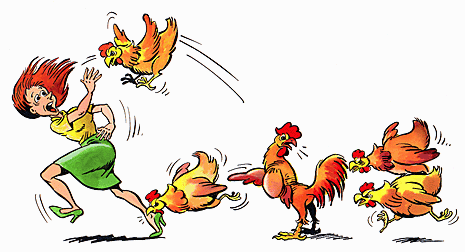
Then the chooks had their own Arab Spring; the two top roosters (brothers) would attack the younger roosters and terrorize the hens so much that egg production was falling. One of them even tried to attack me.
I was getting ready to give them the chop when they decided that they would both attack Harold the young Issa brown rooster, a quieter rooster I have never known.
Something in Harold must have snapped - the fight was monumental. When the feathers, dust and blood finally settled one of the brothers lay dead and the other was at the bottom of the pecking order.
It was poetic justice at its best. The hens are happy now, I’m happy egg numbers are up and Harold has reverted to his normal well-behaved self. Except when the surviving brother (now named Gaddafi) tries to pick on someone.
After Arnold and I had finished the hay and our talk I felt much better about life in general. So I thought how can I share the knowledge?
Answer - I’m going to have a T-shirt printed, with “Talk To A Cow” on the front and on the back “NULLUS ANXIETAS MATEUM”.
Labels:
humour,
rural affairs
Subscribe to:
Comments (Atom)