After Australian Prime Minister Scott Morrison abandoned the Coalition's proposed National Energy Guarantee which would allegedly reduce polluting emissions and lower electricity retail costs, the energy sector remains in disarray.
Wednesday, 17 July 2019
So much for Liberal-Nationals boasts concerning regional jobs growth in 2019
After Australian Prime Minister Scott Morrison abandoned the Coalition's proposed National Energy Guarantee which would allegedly reduce polluting emissions and lower electricity retail costs, the energy sector remains in disarray.
One
hundred and sixty-five jobs are
at
risk across
regional News South Wales as Essential
Energywhose operational footprint covers 95 percent of the state apparently
considers downsizing employee numbers as a cost-cutting measure is the best way to gain the Morrison Government’s approval.
In
all probability hoping that this move will appease Morrison and he will then decide to forget his promise to force all energy companies to lower their prices.
Sadly,
this is just the sort of short-sighted approach to cost cutting which
‘The
Liar From The Shire’
would approve.
Though
how downsizing staff leads to better customer service under
The
Energy Charter
I am at a loss to understand.
The
Daily Examiner, 4 July 2019, p.1:
Methods
used to determine who stays in a job at Essential Energy have been
likened to the battle for survival in sci-fi film Hunger Games.
The
Electrical Trade Union claims workers will be pitted against each
other to save their own job and asserts that the company has told
workers Grafton will be one of the hardest hit in a plan to slash 165
jobs across regional NSW.
The
Daily Examiner was told of workers being asked to write letters to
state why they should keep their job.
ETU
secretary Justin Paige slammed the announcement of cuts, saying the
use of forced redundancies along with a “Hunger Games” style
competition between workers was causing unnecessary hardship.
“Workers
have been given less than a week to respond to the plan, with the
first staff to be made forcibly redundant as early as July 10, but we
are examining every legal and industrial avenue available to stop
them,” Mr Paige said.
“The
worst part is many of these cuts will be undertaken through what
management have called a ‘merit selection process’, which will
essentially pit workers against each other to save their own job.
Clarence
MP Chris Gulaptis and Deputy Premier John Barilaro poured scorn on
the proposed job losses…...
The
Daily Examiner,
5 July 2019, p.3:
The
ALP has accused Nationals MPs of hypocrisy over their response to
Essential Energy sacking 182 employees.
Member
for Lismore Janelle Saffin said it was the height of hypocrisy for
Nationals MPs like John Barilaro and Chris Gulaptis to claim they are
fighting against Essential Energy’s regional job cuts.
Ms
Saffin said the Nationals allowed Essential Energy to be corporatised
so they could bleat all they like but lost their say in the matter
when they agreed to the sell-off.
“The
Nationals’ excuse was that a Restart fund would be set up from the
proceeds of the sale and that regional and rural NSW would get 30 per
cent of the proceeds annually,” Ms Saffin said. “They never even
delivered and failed regional NSW. The Auditor General has showed
year after year since 2011 that Restart has not met the Nationals’
30 per cent target – it was 17 per cent last year.
“The
Nationals lost three seats at the recent State election, which is why
John Barilaro is now posturing that his hapless party is suddenly
independent of the Liberals.”
Ms
Saffin said she was saddened to hear of Essential Energy’s plan to
sack more workers as it was a cruel blow to them and their families,
and would make it harder on remaining workers maintaining or
upgrading infrastructure.
“Essential
Energy, which operates electricity poles and wires across 95 per cent
of the state, has gutted more than 2000 jobs from their ranks since
2015,” Ms Saffin said.
“It
is hard enough to get permanent roles in the regions and while jobs
have grown in the city it has been slow here…..
The
Daily Examiner,
8
July 2019, p.3:
Essential
Energy has hit the pause button on its moves to cut 182 job across
Northern NSW after a Fair Work Commission meeting which called for
the company to provide further information to its workers.
On
Friday power industry unions reached an in-principle agreement with
Essential Energy in the Fair Work Commission that paused planned job
cuts until additional consultation took place.
The
agreement means no jobs will be lost before mid-August, with unions
given an opportunity to propose alternative cost saving measures and
initiatives that could avert the need for redundancies.
Essential
Energy committed to distributing information to all employees by July
19 that includes: the justification for role reductions, the specific
impacts of cuts on remaining team members, and details of the tasks
or functions that will cease to be performed.
Essential
Energy also committed to consider alternative savings measures before
redundancy decisions.
Electrical
Trades Union secretary Justin Page welcomed the outcome, saying it
was vital workers could identify alternatives to regional job cuts.
“This
is a tough time for Essential Energy workers, their families and
colleagues,” Mr Page said.
“After
four years of deep staffing cuts at Essential Energy – which has
not only devastated those workers directly impacted, but has had
profound impacts on service delivery and regional communities –
today’s reprieve is extremely welcome, but is just the start…..
Tuesday, 16 July 2019
Housing affordability for NSW North Coast renters is beyond the reach of many
On 1 May 2019 The Financial Review reported on the top twenty federal electorates with the highest level of rental stress in Australia.
The Northern Rivers federal electorates of Richmond and Page were placed in 3rd & 8th positions respectively, with a total of 13,937 household experiencing rental stress .
While the mid-North Coast federal electorates of Lyne and Cowper came in 6th & 10th place, with a total of 13,283 households under rental stress.
Anglicare Australia's 2018 Rental Affordability Snapshot demonstrates that this stress is an ongoing problem with housing affordability for those on low incomes on the NSW North Coast.
In 2018 five of the six NSW local government areas with the most unaffordable rentals were on the Far and Mid North Coast.
A St Vincent de Paul Society spokesperson is reported in The Daily Examiner this week highlighting the fact that people on the North Coast are going without food in order to keep their rental accommodation.
The Abbott-Turnbull-Morrison Government spends literally billions supporting property speculators and investors in their aspirations to become personally wealthy, but is ignoring the plight of low income renters trying to keep a roof over their heads.
If it will no longer invest in affordable housing through adequate targeted federal funding tied to the states increasing social/community housing stocks, the least it can do is raise the Commonwealth Rental Assistance Payment available to eligible low-income individuals and families.
Australian Prime Minister Morrison's relentless hammering of the poor and vulnerable set to continue?
The
Guardian,
7 July 2019:
The
Morrison government says it remains committed to a plan criticised as
“brutal” to dock the welfare of those who repeatedly fail to pay
state fines, and may still proceed with cuts to student payments
claimed by the unemployed, the disabled and sole parents.
The
Coalition introduced a number of welfare measures in 2017 which drew
the ire of social service groups but ultimately never came into
effect because the government failed to win the support of the Senate
or the states and territories.
Guardian
Australia reported this month that internal documents suggested the
contentious plan to drug test welfare recipients was not a priority,
but the government has insisted it remains on its agenda.
Other
welfare proposals from the last parliament included about $90m in
cuts to student payments, legislation to automatically deduct rent
from welfare recipients living in social housing, which critics said
could put family violence survivors at risk, and a plan to impose the
“demerit point” compliance scheme on those doing the remote
work-for-the-dole program, which has seen payment suspensions
surge…...
But
the spokesman did confirm the government still intended to create the
scheme to automatically dock 15% of payments for those who have
unpaid fines…...
“The
Encouraging Lawful Behaviour of Income Support Recipients proposal
remains government policy and requires legislative approval,”
Ruston’s spokesman said…..
Labor
had opposed the cuts to the $208-a-year pensioner education
supplement and the $32.20-a week education entry payment, which are
intended to help low-income people with the cost of study.
The
changes would save the budget $95m over five years, but the
opposition said the policy would hurt people with disability, carers,
sole parents and the unemployed.
The
Australian Council of Social Service has previously lashed the plan
to dock welfare payments from people with court-ordered state fines
as “particularly brutal”.
The
proposal would automatically dock 15% of an income support payment,
but critics say it will push vulnerable people into homelessness.
Welfare
groups including the Australian Unemployed Workers Union have also
expressed grave concerns about a plan announced last year to link
Newstart recipients to farm work using the national database.
The
unemployed would face losing their welfare payments for four weeks if
they turned down what the government described as a “suitable job
without reasonable excuse”.
The
department of employment confirmed the policy would begin in July
next year.
Monday, 15 July 2019
Clarence Valley NSW has recorded its highest tourist numbers ever
Clarence Valley Council, media release, 9 July 2019:
Record tourism numbers in the Clarence
THE Clarence Valley has recorded its highest tourist numbers in history, with an estimated 1.3 million visitors coming to the region during 2018.
Tourism Research Australia figures show a 22% increase in international, domestic and day visitors from 2017 to 2018, continuing an impressive increase over the past three years.
Clarence Valley Council destination management officer, Lou Gumb, said the word was getting out that the Clarence Valley region boasted some of the finest scenery, adventure and nature-based experiences that Australia had to offer.
“The Clarence Valley offers a diverse array of quality and unique offerings,” she said.
Key Clarence Valley tourism results for 2018 are:
Domestically, we welcomed 680,000 overnight visitors who stayed 2,355,037 nights.
Internationally, the Clarence Valley received 27,000 visitors who stayed 157,830 nights.
Day visitors to the Clarence Valley totalled 600,000. Council’s economic development manager, Elizabeth Fairweather, said Tourism Research Australia’s figures showed a big turn around after a steady decline in tourism numbers over the past 10 years.
“We hit the lowest point in 2014 when 857,000 visitors were recorded as coming to the area,” she said.
“But here we are at the end of 2018 with a whopping 52 per cent increase on this in a relatively short space of time.
“The graph line is now on a fast incline but this hasn’t happened by accident. We’ve worked incredibly hard to create awareness of the Clarence Valley, support the local industry, encourage nature-based sporting events and overall enhance the region’s nature-based experiences, targeting active families.”
Ms Gumb said there had been a multifaceted approach that included working with the local tourism industry, government bodies including Destination NSW and Tourism Australia, National Parks and Wildlife Service, Crown Lands and the Forestry Corporation.
“We are working to attract visitors and to create an atmosphere that encourages people to stay longer, spend more and return year after year because they have had such a wonderful time in our very special part of the world,” she said.
“You only have to look at our @myclarencevalley on social media to see how many people have already fallen in love with the area and can’t wait to come back. Even those who have not yet visited the Clarence Valley are fast realising the Clarence Valley should be on their to-do list.”
Mayor Jim Simmons said the impressive numbers were charging the region’s economy, generating jobs and driving investment in local communities as tourists chose to visit the Clarence Valley.
“The results speak to the broad appeal of the Clarence Valley region,” he said.
“We really do have something for everyone, with our renowned Clarence canoe and kayak trail, Grafton Jacaranda season, Yuraygir coastal walk, tourist towns including Yamba, Iluka, Brooms Head, Wooli and Ulmarra.
“Visitors are coming for our beaches and rivers, bush adventures, laid-back lifestyle, world-class food, events and just to kick back and relax if that’s all they want to do.”
Want to know more about visiting the Clarence Valley? Head to www.myclarencevalley.com
Release ends
Labels:
Clarence Coast,
Clarence River,
Clarence Valley,
statistics,
tourism
The national scandal that is the Murray-Darling Basin continues unabated
On
the morning of Friday 12 July 2019 NSW
Water's real-time
records showed
that much of the Murray-Darling Basin river systems where they pass
through New South Wales are still recording less than 20 per cent
water flows, with some sections of the Darling River still regularly
recording zero flows and water levels as low as 0.16 of a metre.
Water
sustainability and environmental water flows have been in crisis for
decades within the Basin and no solution is in sight.
Here is a snapshot of the latest information........
ABC
News,
7 July 2019:
Australian
taxpayers have given a huge corporation more than $40 million,
enabling it to expand irrigation in the Murray-Darling Basin under an
environmental scheme that has been labelled a national disgrace.
Four
Corners can reveal that more than $4 billion in Commonwealth funds
has been handed over to irrigators, which has allowed them to expand
their operations and use more water under the $5.6 billion water
infrastructure scheme — the centrepiece of Australia's $13 billion
Murray-Darling Basin Plan.
The
scheme is intended to recover water for the rivers by giving farmers
money to build water-saving infrastructure, in return for some of
their water rights.
Some
of the beneficiaries of the scheme are partly foreign-owned
corporations that have used the money to transform vast tracts of
land along the threatened river system, planting thirsty cotton and
nut fields.
One
of the biggest operators is Webster Limited, a publicly traded
company that produces 90 per cent of Australia's walnuts and is 19.5
per cent owned by Canadian pension fund PSP.
Webster
has received $41 million from the water infrastructure scheme to grow
its empire in the Murrumbidgee Valley, in south-west New South Wales,
where it has bought hundreds of square kilometres of land.
The
funding covers more than half of an ambitious $78 million capital
works program by Webster Limited to build dams to store more than 30
billion extra litres of water and irrigate an extra 81 square
kilometres of land, developing much of it into prime, irrigated
cotton country.
Maryanne
Slattery, a former director at the Murray-Darling Basin Authority,
says it is horrifying that a scheme designed to help the environment
is allowing irrigators to use more water.
"That
program was supposed to reduce the amount of water that was going to
irrigation, when it's actually increased the opportunities for
irrigation … all subsidised by taxpayers," she said…...
Read
full article here.
Note: It should come as no surprise that Chris Corrigan - who attempted to 'bust' a union and rob Patrick Steverdores workers of their jobs & wage entitlements via a version of the ‘bottom of the harbour’ scheme - is Chairman of Webster Limited.
ABC
Four Corners, 8
July 2019:
Taxpayer
dollars, secretive deals and the lucrative business of water.
"It's
a national scandal." Water economist
Two
years on from the Four Corners investigation into water theft in the
Murray-Darling Basin that sparked a royal commission, the program
returns to the river system to investigate new concerns about how the
plan to rescue it is being carried out.
"How
extravagant is this scheme?... I'd just call it a rort." Lawyer
On
Monday Four Corners investigates whether the contentious plan has
become a colossal waste of taxpayers' money.
"The
Murray-Darling Basin Plan is a triple bottom line fail. It's a fail
for communities, it's a fail for the economy and it's absolutely a
fail for the environment." Business owner
The
river system is the lifeblood of Australian agriculture but right now
it's in crisis. It's experiencing one of the worst droughts on
record, and with mass fish deaths capturing the headlines and farmers
struggling to survive, many are saying the scheme is failing to
deliver.
"I
would characterise it as pink batts for farmers, or pink batts for
earth movers. It all had to happen in a short space of time."
Contractor
Billions
of taxpayers' dollars are being poured into grants handed to
irrigators in an attempt to save more water. Four Corners
investigates exactly how the money is being spent.
"I'm
a taxpayer. I don't agree with the scheme. I think it's actually too
expensive." Farmer
Some
irrigators say this is a once in a lifetime opportunity to transform
their businesses.
"With
a bold initiative, having the basin plan and the government investing
in irrigated agriculture, you get an opportunity to basically
reset... for the next 50 years." Irrigation CEO
Others
question who is actually gaining the most from the generous scheme.
"We're
degrading the rivers at the same time as we're handing out money to a
few individuals to realise huge economic gains at public cost."
Ecologist
For
those with access to water, there are lucrative sales to be made.
Water prices have hit record highs turning it into liquid gold.
"Anyone
can come in and buy water. You don't even have to be a
farmer...You're going to make money out of it, and that's what a lot
of people are doing, unfortunately." Farmer
Others
worry that the scheme is encouraging the planting of crops even
thirstier than cotton, creating a potential time bomb.
"There's
been an explosion in the production of nuts in the Murrumbidgee, and
more broadly in the Murray-Darling Basin...This may well be a time
bomb." Former water official
Four
Corners investigates how the scheme is being regulated and whether
water users and the authorities responsible are being properly held
to account.
"We're
talking about billions of dollars in taxpayers' money on a scheme
that many, many capable and reliable scientists have said, this isn't
going to work." Lawyer
Abc.net.au,
9 July 2019:
Two
years on from Pumped,
the Four Corners investigation into water theft in the Murray-Darling
Basin that sparked
a royal commission, Monday night’s report Cash
Splash investigated new concerns about how the plan to
rescue the fragile and vitally important river system is being
carried out, probing the infrastructure grants scheme which is now
the centrepiece of the $13 billion Murray-Darling Basin Plan.
The
investigation revealed tens of millions of dollars intended to
restore the Murray-Darling Basin is helping big businesses expand
irrigation and access huge volumes of water that would have flowed
into communities and habitats downstream.
The
aim of the story was to speak with people who have first-hand
evidence of how the grants scheme is operating. It drew on a wide
cross-section of the community affected by the scheme, including
farmers and irrigators who have received the funding or been involved
in its expenditure, scientists and economists who have gathered and
analysed data on its effects, community leaders, former government
officials and current and former Murrumbidgee Irrigation staff.
The
interviewees on the program were:
Julie
and Glen Andreazza, NSW Farmers of the Year
Brett
Jones, CEO, Murrumbidgee Irrigation
Anthony
Kidman, former Murrumbidgee Irrigation Project Manager
David
Papps, former Commonwealth Environmental Water Holder
Professor
Richard Kingsford, Ecologist, UNSW
Richard
Beasley SC, Former Senior Counsel Assisting the SA Royal Commission
into the MDBP
Prof
Sarah Wheeler, Water Economist, University of Adelaide
John
Kerrigan, Earthmover and now irrigator and recipient of
infrastructure grants
Maryanne
Slattery, former Director of Environmental Water at the MDBA and now
senior Water Researcher, Australia Institute
Kelvin
and Glen Baxter, farmers
Prof
Quentin Grafton, UNESCO Chair in Water Economics, ANU
Paul
Pierotti, Vice President of the Griffith Business Chamber
Tony
Onley, Business Development Coordinator, Murrumbidgee Irrigation
Emma
Carmody, Senior Solicitor, Environmental Defender’s Office
Matthew
Ireson, Grazier
Four
Corners requested an interview with Environment Minister Sussan Ley,
who is responsible for the Commonwealth Environmental Water Office
and is the Member for Farrer, which includes the Murrumbidgee Valley
where the story was filmed.
Minister
Ley declined to be interviewed and her spokesperson told Four Corners
no-one from the government would comment for the story.
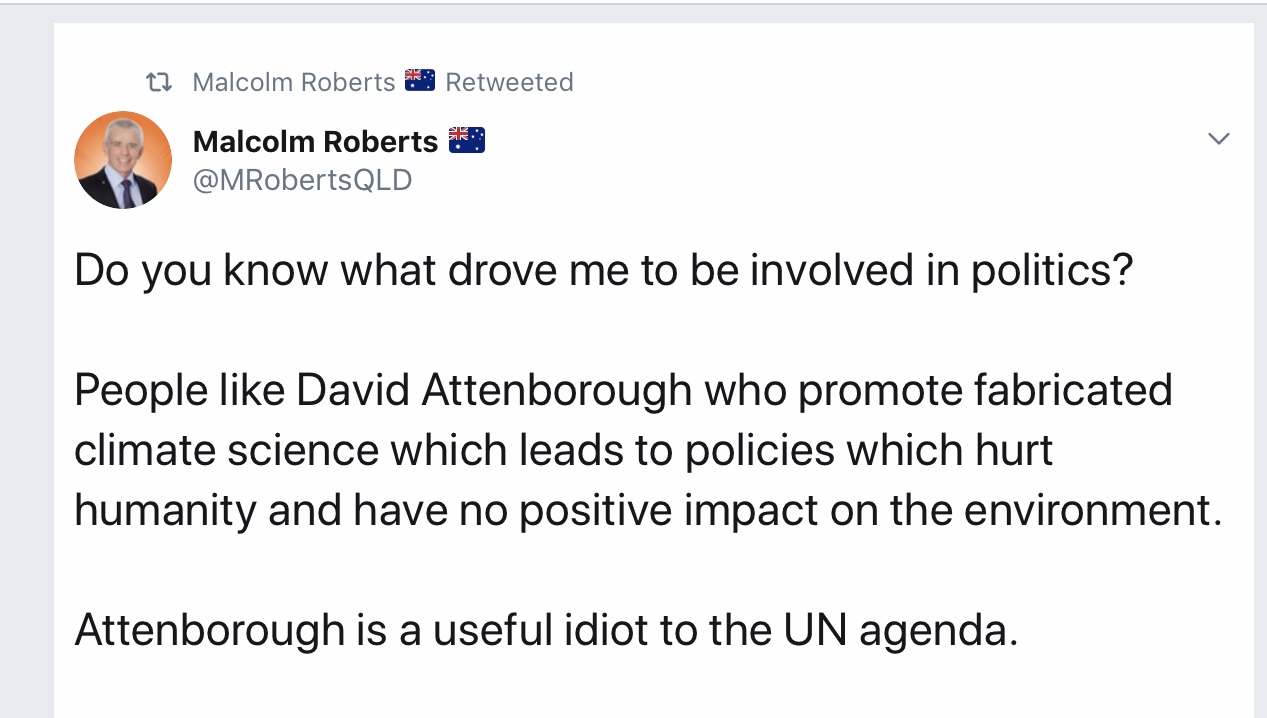
Is this bloke an idiot or is this bloke an idiot? You make up your own mind.
Labels:
Fitz on sunday,
Malcolm Roberts,
the sun herald
Sunday, 14 July 2019
Government of Japan sponsored whalers finally leave the Southern Ocean
![]() |
| Nisshin Maru is seen after it returned to port in Shimonoseki, Yamaguchi Prefecture at the end of its final whaling voyage into the Southern Ocean Japan Times |
ABC
News, 2 July 2019:
Amid international criticism, several vessels left ports across the nation for the first for-profit hunt in 30 years. But this time, they are only going to hunt whales in Japanese waters.
Last December, Japan quit the International Whaling Commission, the body responsible for protecting global whale populations.
That meant the country could return to commercial whaling, but Japan had to give up a legal right to its so-called 'scientific whaling program' in the Southern Ocean.
Last year alone, Japan killed 333 minke whales in the Southern Ocean in the name of science.
Exiting the IWC and giving up that Southern Ocean whaling program was a "stupid" decision according to Japan's former chief IWC negotiator Masayuki Komatsu.
"We should go because it's a common property of the ocean," Mr Komatsu said.
Japan's
factory whaling mothership, the 'Nisshin Maru' has scrubbed
'research' from its hull and set out to sea as part of the country's
resumption of commercial whale hunting.
Amid international criticism, several vessels left ports across the nation for the first for-profit hunt in 30 years. But this time, they are only going to hunt whales in Japanese waters.
Last December, Japan quit the International Whaling Commission, the body responsible for protecting global whale populations.
That meant the country could return to commercial whaling, but Japan had to give up a legal right to its so-called 'scientific whaling program' in the Southern Ocean.
Last year alone, Japan killed 333 minke whales in the Southern Ocean in the name of science.
Exiting the IWC and giving up that Southern Ocean whaling program was a "stupid" decision according to Japan's former chief IWC negotiator Masayuki Komatsu.
"We should go because it's a common property of the ocean," Mr Komatsu said.
"The
more Australia claims that it is their own territory and their own
oceans, the more that Japan [should keep going] because Australia is
a minority.
"Japan
and the US and other nations — China and Russia — we are a
majority," he said.
Whaling
Senator
WHISH-WILSON (Tasmania) (12:05): I seek leave to amend general
business notice of motion No. 10
Leave
granted.
Senator
WHISH-WILSON: I move the motion as amended:
That
the Senate—
(a)
notes that:
(i)
Japan has turned its back on the international community by
recommencing commercial whaling for the first time since 1988,
(ii)
Japan has also turned its back on a rules-based order by leaving the
International Whaling Commission (IWC) which has been integral to
preventing some species of whales from becoming extinct,
(iii)
Norway and Iceland have reduced commercial whaling in recent years in
response to the negative impact it is having on tourism, and
(iv)
whale watching is a viable business in many parts of the world, and
that it is a much more sustainable business than killing whales; and
(b)
condemns Japan, Norway and Iceland for their commercial whaling, and
implores them to support whale watching rather than whale killing.
Senator
DUNIAM (Tasmania—Assistant Minister for Forestry and Fisheries and
Assistant Minister for Regional Tourism) (12:05): I seek leave to
make a short statement.
The
PRESIDENT: Leave is granted for one minute.
Senator
DUNIAM: The Australian government is disappointed that Japan has
resumed commercial whaling, following its withdrawal from the
International Convention for the Regulation of Whaling and its
decision-making body, the International Whaling Commission. Australia
has publicly urged Japan to return to the convention and the
commission as a matter of priority. The government welcomes Japan's
decision to stop whaling in the Southern Ocean and its commitment to
continue to cooperate with the commission. The government's position
on whaling has not changed: we remain resolutely opposed to all forms
of commercial and scientific whaling. Japan is well aware of our
position.
Question
agreed to.
Labels:
Antarctica,
Australia-Japan relations,
whales
Subscribe to:
Comments (Atom)