Thursday, 12 May 2016

Federal Election 2016: looking at the ICIJ Panama Papers searchable database


Some observations after an initial look at the ICIJ Panama Papers searchable database* (which includes Offshore Leaks data), with regard to listings of companies and individuals associated with Australia……

For some who are listed it appears to be a bit of a family affair, for others a lone foray into off-shore company registration.

Some associated with registered companies are investors, while others are active players in the mining, smelting, construction, manufacturing, banking, finance, risk management, insurance and marketing sectors.

There’s the odd investment manager or two, at least one specialist in fine art, some professional property directors and company secretaries, self-employed consultants and a media type.

One of Australia’s rich listers and a National Party politician (appointed not elected) also make appearances on this database.

As does a company which had as directors one multimillionaire former Labor premier of NSW and another multimillionaire who who went on to be a Liberal prime minister – for reasons unknown full details of this company have not been included in the searchable section of the ICIJ database to date.

What there doesn’t appear to be any indication of is that ordinary workers on the average wage went to Mossack Fonceca or other financial advisors to set up a companies in a low taxing jurisdiction such as Panama, the British Virgin Islands, Singapore or Hong Kong.

Off-shore registration appears to be something indulged in primarily by business and industry in this country as well as those with above average to high levels of personal wealth.

The very groups that Turnbull & Co have given company and income tax cuts in the 2016-17 Budget.

Inevitably there are 2014-15 political donors among those listed on the databases and, just as inevitably, there are some who give more to the Liberals and their Coalition partner than they do to Labor.

Before voting on 2 July 2016 readers might consider clicking on the search link at the beginning of this post and typing in a few individual and company names, to see how these might compare with the known interests of election candidates and those political donors included in documents held at the Australian Electoral Commission Annual Returns Locator Service.  

Where people spend, invest or gift their money says something about their personal and professional ethics.  

* It is not asserted by the creators of these databases that every individual or corporation identified has been involved in unlawful tax evasion or any other form of wrongdoing.

Baird Government creates arbitrary laws constraining the innocent as well as the allegedly guilty citizen


The Crimes (Serious Crime Prevention Orders) Bill 2016 (NSW) (the Bill) is an extraordinary and unprecedented piece of legislation with grave implications for the rule of law and individual freedoms in New South Wales.

The Bill was announced on 22 March 2016 by the Deputy Premier and Minister for Justice and Police the Honourable Troy Grant MP, joined by New South Wales Police Commissioner, Andrew Scipione.
Notice of motion for the Bill and its second reading in the Legislative Assembly occurred on the same day…..

the Bill creates a very real danger of arbitrary and excessive interference with the liberty of many thousands of New South Wales citizens. The powers to interfere in the liberty and privacy of persons, and in freedoms of movement, expression and communication, and assembly are extraordinarily broad and unprecedented, and are not subject to any substantial legal constraints or appropriate judicial oversight….. [A submission of the New South Wales Bar Association, 13 April 2016]

the Criminal Legislation Amendment (Organised Crime and Public Safety) Bill 2016 (NSW) (the Bill) has serious implications for the rule of law and individual freedoms in New South Wales.
vii. in relation to a long duration PSO, there is no upper limit on the duration of the order; viii. in many cases, a person the subject of an order a will have no means of knowing the basis upon which a senior police officer has reached the satisfaction required by s 87R - in accordance with clause 87T(4), a statement of the reasons for making or varying a PSO must not contain information that would result in the disclosure of a criminal intelligence report or other criminal information held in relation to a person;
ix. there is no right of appeal to the Supreme Court in relation to a PSO which is not a long duration PSO. In the case of an appeal against a long duration PSO, the non-disclosure of criminal intelligence and other criminal information held in relation to the person, and the hearing of argument in the absence of the person and their representative (unless the Commissioner approves otherwise) is likely to render the right to appeal practically meaningless;
x. clause 87ZA creates a criminal offence of contravening a PSO carrying a maximum penalty of imprisonment for 5 years, and in contrast to 32 of the Serious and Organised Crime (Control) Act 2008 (SA), there is no defence of reasonable excuse for being within or entering a specified area; (b) there has been no public debate about the Bill, and no case made as to why such broad and far-reaching powers should be conferred on the police;….. [A submission of the New South Wales Bar Association, 2 April 2016]

On 4 May 2016 the NSW Parliament passed the Crimes (Serious Crime Prevention Orders) Bill 2016 without amendment.

On the same day it passed the Criminal Legislation Amendment (Organised Crime and Public Safety) Bill 2016, again without amendment.

Text of the Crimes (Serious Crime Prevention Orders) Bill 2016 can be found here and text for the Criminal Legislation Amendment (Organised Crime and Public Safety) Bill 2016 here.

A look at this further curtailing of the rights of citizens residing in New South Wales.......

Sydney Criminal Lawyers, 3 April 2016:
The government is proposing new laws which would empower senior police officers – without permission from a court – to issue “public safety orders” banning individuals who police claim are a “risk to public safety” from attending specified public places for 72 hours.
Police cannot presently do this without a court order…..
There are concerns that police will use these new powers to target individuals who don’t ‘tow the government line’; such as leaders of protest groups and other outspoken individuals – preventing them from attending demonstrations and rallies.
The Guardian, 14 April 2016:
New police powers that could see citizens in New South Wales face bans on their employment, restrictions on movement and curfews without ever having committed an offence would set up a “rival criminal justice system” and should be scrapped, the New South Wales Bar Association has warned.
The NSW government has sought to introduce new powers called serious crime prevention orders.
The bill would give police similar powers to those they have to seek and impose control orders on terrorism suspects – but they could be applied to all citizens in NSW who are alleged to have some proximity or involvement to a serious crime, without a person ever being found guilty of an offence.

They would allow orders to be made on any citizen restricting their movement, who they associate with, who they work for and whether they can access the internet.

Even when a person is acquitted of a criminal offence police could still seek such an order.

The penalty for breaching an order could be up to five years’ imprisonment or a $33,000 fine for an individual, or $165,000 for a corporation.

In a scathing submission the NSW Bar Association criticised the government’s limited consultation with legal groups and its attempt to rush the bill through NSW parliament.

“No evidence has been cited as to the ineffectiveness of the administration of criminal justice by a process of trial for ‘reducing serious and organised crime’ in New South Wales,” the submission said.

“The bill effectively sets up a rival to the criminal trial system and interferes unacceptably in the fundamental human rights and freedoms of citizens of NSW.”

It said the government had failed to explain why the powers should be expanded in a manner “so contradictory to long-settled principles concerning the adjudication of criminal guilt by a fair trial”.

The police minister, Troy Grant, has said that the measures would provide law enforcement agencies with a more effective means of reducing serious and organised crime by targeting business dealings and restricting suspects’ behaviour.

Under the new provisions, the NSW police, the NSW Crime Commission and the NSW director of public prosecutions could seek orders from a judge, who must be satisfied there are “reasonable grounds” it would protect the public by restricting or preventing serious crime-related activity.

But the bar association said it was unclear why the laws were needed. While they could be applied to individuals who had been convicted of a serious criminal offence, they would also be applicable to behaviour that was considered “serious crime-related activity” without an offence needing to be proven.

The orders could also be sought on the basis of hearsay and other forms of tendency evidence that would normally be inadmissible in a normal criminal trial.

The bar association warned that the laws posed an unacceptable interference with citizens; right to freedom of expression, association and privacy. They also noted that the orders were of “doubtful constitutional validity”……

The Guardian, 7 May 2016:
Legal Aid NSW will review its policies to consider when and how Australians who face controversial new crime prevention orders will be eligible for legal assistance.
On Wednesday, a bill passed by the New South Wales upper house granted police powers to create serious crime prevention and public safety orders.....
Because the police powers are so novel and are considered to be civil, rather than criminal, they don’t fall neatly into Legal’s Aid’s existing sets of guidelines for when they will provide legal aid.
Legal Aid NSW has separate criteria for criminal and civil matters and in what circumstances it can provide legal assistance for them.
While the powers have not yet come into effect, a spokeswoman for Legal Aid NSW confirmed that it was considering how cases would be dealt with.
“Legal Aid NSW will be reviewing its policies to determine how matters brought under this bill should be dealt with,” she said.
“Any changes to policies would have to be approved by the board.
“If a matter arises before this has happened, the CEO can exercise discretion to determine applications on a case by case basis.”......
The Redfern Legal Centre warned that the new powers would essentially remove equality before the law.

Nationals doing what Nationals do best - claiming political credit for the work of others


The story so far…….

The Inverell Times, 6 May 2016:

SENATOR John Williams stood by his comments on social media on Thursday, which accused Independent candidate Tony Windsor of falsely claiming credit for the funding of Bindaree Beef’s bio-digester program.
“Tony Windsor claims credit for Bindaree Beef digester funding but it was Barnaby Joyce who actually got the funding!” Senator William’s post on Twitter read, and Wacka declared it as absolute fact……
Funding through the Gillard-Rudd governments for Bindaree’s bio-digester program was announced by Mr Windsor at the beginning of July 2013, after the pilot plant had operated successfully for six-months with better than expected results.
Speaking at Tony Windsor’s meeting in Flanders House at Inverell on Wednesday evening, Bindaree’s owner, John McDonald seemed in no doubt about the origins of the funding.
“I’d like to congratulate Tony for what he has done for Bindaree Beef,” he said.
“Julia Gillard, $23 million, just an incredible result that I couldn’t comprehend it.
“The problems we’ve got, we’re only a very, very small company, we’re fighting outside our boundaries. We’re competing with the biggest companies in the world and at this stage we’re struggling to get the Prime Minister to complete the project.”

Now Barnaby Joyce was a Senator for Queensland from July 2005 until August 2013 when he resigned from parliament, so it is highly unlikely that he was capable of securing that $23-million “discretionary” grant awarded to Bindaree Beef.

In fact, because Tony Windsor was the sitting Independent Member for New England at the time (and was part of the minority Rudd-Gillard Labor Government) it is more likely that he positively contributed to this particular grant coming Bindaree Beef’s way in July 2013.  

Indeed Tony Windsor is on the record in 2013 stating that he had lobbied then industry minister Greg Combet to get the grant and, that he had “worked with Bindaree for two years” to make the program happen.

In November 2013 Bindaree Beef began lobbying the Abbott Government for an additional $23 million grant.

By then the new Member for New England was Barnaby Joyce MP – having been elected to the House of Representatives at the September 2013 federal election.

The Abbott Government seems to have delayed paying the original $23 million grant dollars to Bindaree Beef for twelve months and, the request for an further $23 million was apparently reduced by the Liberal-Nationals government to $15 million in repayable co-finance from the Clean Energy Finance Corporation.  

What appears to be the facts in this case is that the Gillard Government made an enforceable grant to Bindaree Beef in the last 66 days of Labor’s term in office which the Abbott Government eventually had to honour and, the politician who successfully lobbied on behalf of Bindaree in 2013 was Tony Windsor.

Wednesday, 11 May 2016

Bet there are quite a few Liberal and Nationals MPs who are not thrilled with this 'inspired' piece of political branding


It would appear that Australian Prime Minister Malcolm Bligh Turnbull's desire to capitalise on his somewhat faded personal popularity, as well as distance himself from any further association with former prime minister Tony Abbott's 2013 election campaign, has seen a rather egocentric re-branding of Liberal-Nationals Coalition.

The unfortunate visual re-enforcement of business as usual.......


The new branding…….. 


And the fine print which has Tony Nutt, federal director of the Liberal Party of Australia, taking responsibility for what is possibly campaign mistake number two……


Images found at @mearsey and @KieraGorden

UPDATE

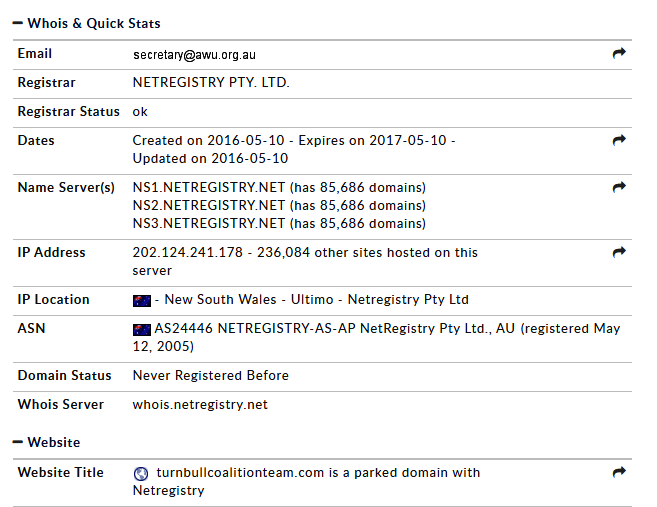
Team Turnbull's branding just took on water as the Australian Workers' Union (AWU) announced on Twitter that Turnbull & Nutt had forgotten to register web domain names applicable to The Turnbull Coalition Team.

So:

Sorry, turnbullcoalitionteam.net is not available.
Sorry, turnbullcoalitionteam.org is not available.

Australian Federal Election 2016: the pain that awaits under a second Abbott-Turnbull Government


If there is a second term for this Abbott-Turnbull federal government it will be one characterized by high public debt and increased borrowings.

With a taxation revenue stream that has been deliberately limited by a $4 billion dollar giveaway to people whose level of earned income already cushions them from the realities experienced by average and low income households and, a further $48.4 billion hit to the revenue bottom line so that government can cut the company tax rate of an est. 2.121 million businesses - 70 per cent of whom don't paid the full rate anyway.

To keep their ship afloat Turnbull & Co would need to implement all those punitive Abbott-era cuts that were predominately aimed at working class households.

Which means among other things, an extension of the 2013-14 indexation freeze on Medicare rebates paid to specialist doctors, GPs and allied health professionals in an attempt to force them to pass on the shortfall to patients as a co-payment. As well as the introduction on 1 July 2016 of upfront payments for x-ray, imaging and pathology services.

Eligibility for Family Tax Benefits will be tightened and government paid parental leave payment rules will be changed to exclude more mothers.

The regressive Good & Services Tax (GST) has also been broaden so that from 1 July 2016 goods purchased overseas via the Internet will attract this tax.

From September this year anyone 22 years and over applying for Newstart Allowance will receive payment at a lower rate - each fortnightly cash transfer for a single unemployed person (with no children) will be $8.80 less and for unemployed couples (with no children) it will be $15.80 less. 

This means that a single person eligible to receive Newstart who applies in September will only have an est. $259.40 per week on which to live and look for work, while couples will only receive an est. $468.50 each week. With average rents in the Sydney metropolitan area ranging between $500-$530 at the beginning of this year, rental stress is likely to increase in unemployed households.

Liberal and Nationals federal politicians are denying that they are conducting "class warfare" yet large tax cuts are going to the top 25 per cent of income earners and will eventually will be extended to businesses with annual turnovers in the billions of dollars, while the economically and socially vulnerable are told they deserve less.

Indeed spatial demographics demonstrate the Coalition's further widening of social and economic division in this country.

On 6 May 2016 The Age revealed that the biggest proportion of income earners who will benefit fully from these personal income tax cuts are in Prime Minister Turnbull's high socio-economic status electorate of Wentworth, where more than a third will have more in their pockets after tax. With the western Sydney electorate of Fowler having the nation's lowest proportion of taxpayers who qualify for the tax cut. In its suburbs of Liverpool, Cabramatta and Green Valley, just one in 20 earners have a taxable income higher than the new tax threshold.

While The Guardian on 7 May reported that, in the relatively lower socio-economic status regional electorate of Page on the NSW Far North Coast, 94.2% of taxpayers would miss out on that same cut in the tax rate because their taxable income was below $80,000 a year. Similarly, neighbouring Richmond and Cowper electorates would see 92.3% and 94.0% respectively missing out on the tax cut.

A brief look at what to expect..........

Unlegislated measures carried forward in the budget estimates—February 2016 update. Date issued: 3 February 2016. Date revised: 12: 30pm, 10 March 2016


The first Turnbull budget will be propped up by about $13 billion of so-called "zombie measures", which are still on the books from the first and second Abbott budgets but have not yet been passed by the Senate.
A parliamentary budget office count for the coming financial year puts the "ghost" measures at $1.7 billion. The biggest are the $600 million from planned cuts to access to Family Tax Benefits, $258 million from the outlawing of alleged double-dipping of maternity leave schemes, and $139 million from increasing co-payments and changing the safety net for the Pharmaceutical Benefits Scheme.

2016-17 Budget PapersStatement 6: Debt Statement, Assets and Liabilities, 3 May 2016:

Net debt is expected to be $326.0 billion (18.9 per cent of GDP) in 2016‑17. Net debt is projected to peak at 19.2 per cent of GDP in 2017‑18, before declining over the medium term to a projected 9.1 per cent of GDP ($264 billion) in 2026-27.The end-of-year face value of Commonwealth Government Securities (CGS) on issue subject to the Treasurer's Direction [government borrowing] is expected to be $497 billion in 2016‑17 and is expected to increase to $581 billion in 2019-20. By the end of the medium term (2026‑27) the total face value of CGS on issue is projected to rise to $640 billion.

2016-17 Budget PapersStatement 4: Revenue, 3 May 2016:

The 2016-17 Budget forecasts for tax receipts, excluding new policy, have been revised down since the 2015-16 MYEFO by $4.6 billion in 2016-17 and $13.5 billion over the four years to 2018-19. Excluding GST, tax receipts are forecast to be $4.6 billion lower in 2016-17 and $14.2 billion lower over the four years to 2018-19…..
the forecast for nominal GDP has been revised down by $27.5 billion over the four years to 2018-19….
In 2016-17, tax receipts as a share of GDP are expected to be 22.2 per cent, lower than the 2015-16 MYEFO estimate of 22.5 per cent.

Financial Review, 3 May 2016:

The government will spend almost $4 billion over the next four years to stop 500,000 taxpayers moving into the second-highest tax bracket…..

2016-17 Budget Papers Part 1: Revenue Measures, 3 May 2016:

The GST will be extended to low value goods imported by consumers from 1 July 2017….
The intent of this measure is that low value goods imported by consumers will face the same tax regime as goods that are sourced domestically.
Overseas suppliers that have an Australian turnover of $75,000 or more will be required to register for, collect and remit GST for low value goods supplied to consumers in Australia, using a vendor registration model.

The Guardian, 4 May 2016:

Asked about the plan to increase the threshold at which the 37% tax bracket kicks in from $80,000 to $87,000 – a tax cut of a bit over $300 a year for the top 25% of earners – the prime minister, Malcolm Turnbull, told ABC radio that even if it was not legislated when he called the federal election at the end of the week it would be implemented "administratively".

On Tuesday the federal government announced it will increase the tobacco excise by 12.5 per cent a year for the next four years.
The plan will cause the price of a packet of 25 cigarettes to rise to about $40, up from $25 today.

ABC News, 5 May 2016:

Prime Minister Malcolm Turnbull has refused to confirm the 10-year cost of the proposal to cut tax for all firms to 25 per cent over a decade.
The Parliamentary Budget Office (PBO) has estimated the proposal, which will be phased in over time and benefit small and medium-sized businesses first, will cost $16.5 billion a year in 2026-27. However, during an interview with Sky News, Mr Turnbull would not confirm that figure, despite being asked more than a dozen times for an explanation.

The Australian, 6 May 2016:

Treasury has revealed a hit to revenue of $48.2 billion over 10 years from the Coalition’s plan to cut company taxes….
The government policy starts by cutting the company tax rate to 27.5 per cent to all companies with a turnover of up to $10 million, taking effect from July….
will be extended to bigger companies year by year, followed by several years of cutting the overall rate to 25 per cent for all companies.


Anyone who signs up for welfare from September 20 will get less than those already on it, creating a two-tiered payments system…..
The government is removing an "energy supplement" 
Newstart Allowance payments have steadily decreased in relative terms over the past two decades to less than 40 per cent of the minimum wage……
The cut comes as national youth unemployment is nearly 13 per cent.

Centrelink, 7 May 2016:

Payment rates for Newstart Allowance…..
single, no children $527.60 [per fortnight]
[couple] $952.80 [per fortnight]


[Newstart non-indexed] Rates include Energy Supplement of $8.80 (single, no children), $7.90 (each member of a couple) and $9.50 (single with children or over 60 after 9 months) per fortnight.

ABC News, 14 January 2016:

The typical Sydney unit rent was $500 a week, while a house was $530 in December 2015.

14 May 2013 Suspension of MBS rebate indexation until 1 July 2014 to align indexation with financial year, announced in 2013-2014 Federal Budget.
13 May 2014 Indexation freeze for specialists, allied health professionals, nurse practitioners, midwives and dental surgeons MBS and DVA rebates until 30 June 2016, announced in 2014-2015 budget.
1 July 2015 Rebate indexation freeze commences…..
The Federal Government is reducing its investment in your healthcare by freezing your Medicare rebates. This means your Medicare rebates will remain the same until 1 July 2018, despite the cost of services increasing. The freeze is a co-payment by stealth and the Government has implemented this measure to reduce the amount it spends on all Medicare subsidised services, including general practice services. ….
Practices where a large proportion or all services are bulk billed will be significantly affected. The rebate freeze will have a detrimental impact on the viability of the practice. These practices may need to consider introducing or increasing out-of-pocket expenses to ensure the sustainability of the practice.
Individual GPs employed by a practice may be asked by their practice to pay a larger service fee to cover increasing practice costs.
Patients will experience a reduction in the value of their MBS patient rebate over time. 
The impacts will be magnified for GPs and practices providing patient services in lower socio-economic areas, where a majority of patients are from vulnerable groups (such as pensioners, Aboriginal and Torres Strait Islander peoples and people on very low incomes.). Many people in these areas cannot afford to meet out-of-pocket costs for care.

Tuesday, 10 May 2016

Clarence Valley Council is not above mindless arboreal vandalism


There are so many noxious weed-classified camphor laurel trees dotted over the Clarence Valley floodplain between Grafton and the sea that local government has studiously ignored the problem of their systematic removal for many decades.

Yet for some reason this particular set of councillors are fixated on four 100 year-old camphor laurels that provide the only real green shade for residents and tourists alike in the main street of the small town of Maclean.

The reason why the multitude of camphor trees in paddocks and along waterways are ignored has always been a puzzle, however these councillors see no inconsistency in their apparent indifference to one group of trees and their zealous dislike of another.

The Sydney Morning Herald, 6 May 2016, p. 17:

We, in our small town of Maclean, have been fighting for years to keep the four, century-old, iconic camphor laurels that line our main street, in our only riverside park, and are about to lose the battle. Yes, we know they are "weeds". The council has ignored all pleas, including a petition signed by 1500 people, and are using the weeds argument to implement its plans. If these were the last four in NSW and Queensland, I would, as an environmentalist, fell them myself. But these beautiful, huge, living things are much loved by our community and have been for decades. Maclean's soul is at risk too.

Nicki Holmes
Maclean

Australian Federal Election 2016: slugging the taxpayer for your wine bill


One of the perks of being Prime Minister of Australia is that liquor flows freely courtesy of the taxpayer’s pocket.

Tony Abbott seems to have done himself proud if the redacted wine bills (all 13 pages of them) covering less than two months between February and April 2015 are any indication: